What is Gamma Knife?
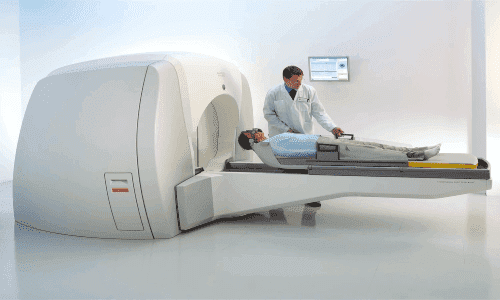
Gamma Knife focuses 192 low-energy radiation beams onto a diseased area in the brain. A high dose is delivered only where the beams intersect, while surrounding healthy brain tissue is spared. It is a non-invasive alternative to traditional surgery — sometimes called “scalpel-free brain surgery” — with accuracy of less than a millimetre.
Key features
- Sub-millimetre precision that protects healthy tissue
- No incision and no bleeding — a non-invasive treatment
- Usually completed in a single session
- Often performed as a day procedure, with no overnight stay
What it treats
Gamma Knife treats benign and malignant brain tumours (such as meningiomas, pituitary adenomas and metastases), arteriovenous malformations, trigeminal neuralgia and some movement disorders such as essential tremor. It works best for lesions smaller than about 3.5 cm.
What to expect
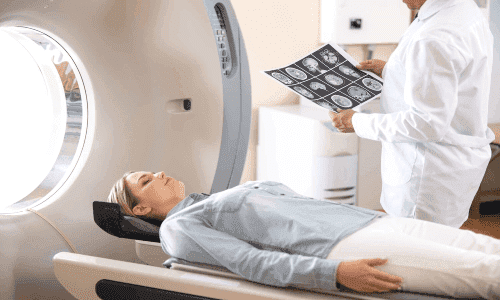
Using a 3D map of your brain from MRI or CT, the team plans the treatment and fits a lightweight frame or custom mask to keep your head still. You lie inside the unit while the beams converge on the target — you stay awake, feel no pain from the radiation, and can talk to the team throughout. The session takes from 30 minutes to a few hours, after which most patients go home the same day.
Advantages
- No incision, stitches or risk of bleeding
- No general anaesthetic needed
- Usually no hospital stay
- Fast recovery — most return to normal life the next day
- Minimal risk to surrounding healthy brain tissue
Good to know
Side effects are rare and usually temporary — mild swelling, headache or fatigue that settles within days. The effect of treatment is gradual: targeted cells shrink or become inactive over months, so follow-up MRI scans (often at 3, 6 and 12 months) track your progress.